
Executive scope of work
Khalda has the technical and financial capability to execute — and hand over to consultants — the following items.
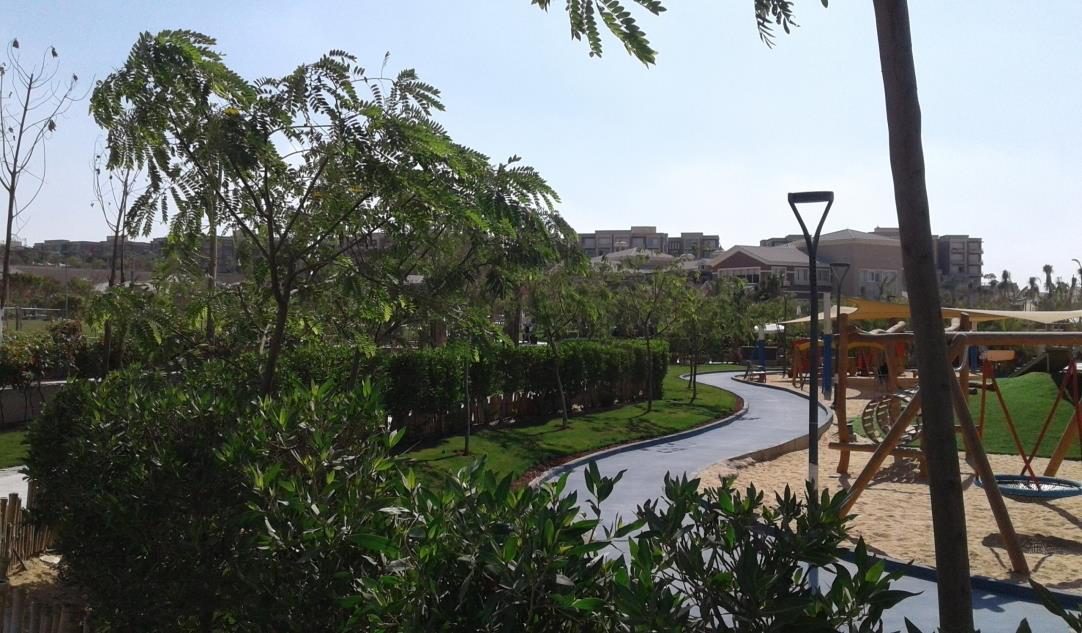 Softscape
Landscape Works
We build the planted landscape with full engineering care — from species selection to soil calibration — for sustainable, uniform growth.
Scope of work
- Supply and planting of trees, palms and shrubs, matched to standard specifications (Caliper & Height)
- Natural turf lawns using high-quality, salt-tolerant seed and rolls
- Preparing agricultural soil mixes and calibrating acidity and salinity (pH & EC) for each site
- Plant selection suited to each region's climate and soil
Technical notes
Trees are specified by caliper (trunk diameter) and height, so what arrives on site can be checked against the approved schedule.
Soil mixes are adjusted per site; pH and EC (electrical conductivity, a proxy for salinity) are measured and corrected before planting.
Coastal and desert sites favour drought- and salt-tolerant species; shaded or irrigated courtyards allow a wider palette.
Warm-season grasses are typical for Egypt's climate; salt-tolerant grasses are chosen where irrigation water or soil is saline.
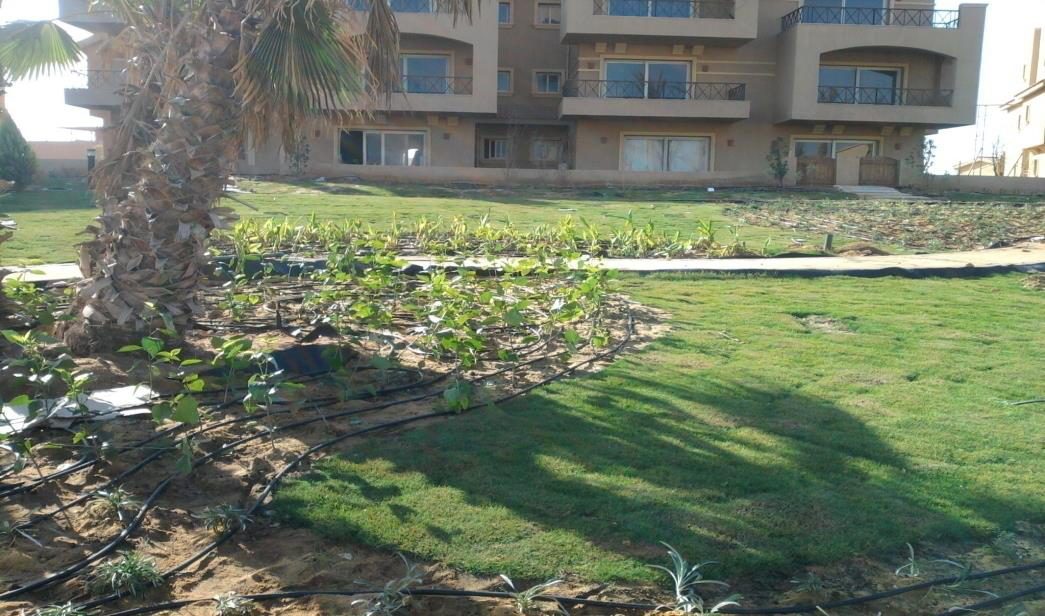 Smart Irrigation
 Networks
We design and build modern, smart irrigation networks that balance water-use efficiency with automatic control at every point on site.
Scope of work
- Designing shop drawings and carrying out hydraulic and friction-loss calculations
- Installing main and branch irrigation lines (UPVC & polyethylene) and testing them at design pressures
- Installing smart control systems (Smart Controllers) and pump stations
- Sub-surface drip irrigation for planting on concrete slabs and roofs
- Converting manual irrigation to central control with weather units
Technical notes
Pipe sizes and pump duty come from flow and friction-loss calculations, so pressure and flow reach the last emitter on the line.
UPVC for rigid main lines; polyethylene for flexible branch and drip lines, joined by thermal fusion welding for leak-free joints.
Networks are tested at their design pressures before handover — leaks are found on our schedule, not the client's.
Controllers and weather units schedule irrigation to conditions, replacing guesswork with consistent, measured watering.
Which irrigation system fits which site
| System | Best suited for | Why it works |
|---|---|---|
| Drip & sub-surface drip | Planting beds, shrubs & trees, slab/rooftop planting, farms (e.g. 2,000 feddans at Al Mamlaka Farms) | Delivers water at the root zone with minimal evaporation; works with fertigation. |
| Sprinklers & rotors | Lawns and large turf areas such as clubs and compound greens | Uniform coverage over open grass; zoned by head type and exposure. |
| Centre-pivot | Large open-field farms (e.g. 3 pivot units across 360 feddans) | Automated coverage of very large areas with low labour. |
| Central control + weather units | Large compounds and clubs (e.g. Palm Hills Phases 4, 7 & 8 conversion) | Replaces manual irrigation with scheduled, weather-aware watering managed from one point. |
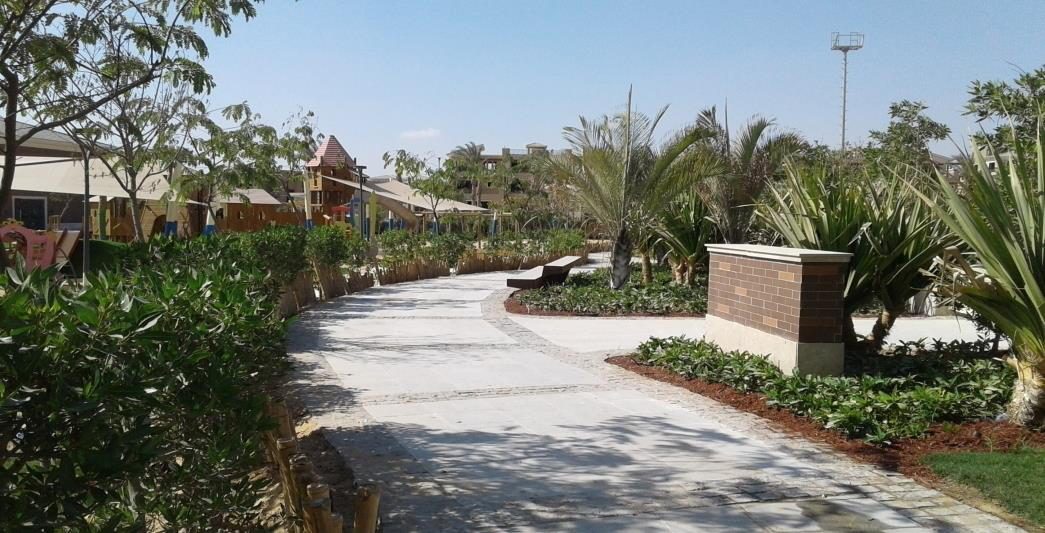 Hardscape & Water Features
Water Features & Hardscape
We execute a site's solid details with high precision — from walkways to artificial water bodies.
Scope of work
- Walkways, pergolas, interlock, marble and stamped concrete — executed with care for levels and rain-water drainage
- Artificial lakes and waterfalls using geotextile layers and HDPE insulation, tested thoroughly
- Distinctive features such as vertical green walls and fountains
Technical notes
Every hardscape surface is set to levels that carry rain water away from buildings and toward drainage points.
Interlock, marble and stamped concrete offer different looks and budgets; the sub-base and edge restraint matter as much as the finish.
Lakes and waterfalls are lined with HDPE over geotextile and tested, so the water stays where it was designed to be.
Vertical green walls bring planting to entrances and boundaries where ground space is limited.
How we solve site problems
Recurring site challenges and the engineering approach we apply — drawn from our flagship projects.
Planting over concrete — without overloading it
Planting on a roof slab demands proper planters and insulation, lightweight soil, and drainage that works at full efficiency. We study the weight of soil and plants against the slab's load capacity first, then build the section below.
- Sub-surface drip irrigation matched to each plant type
- Sloped drainage with fittings that prevent sediment build-up
Keeping water away from foundations
Where topography changes sharply and the soil drains poorly, irrigation and rain water can pool around foundations. We re-survey the site, issue revised grading plans, and add a sub-surface drainage network.
- 1Surface slopes of no less than 1.5% toward drainage points
- 24-inch perforated pipes collecting and carrying water to the outlet
- 3Geotextile filter and graded gravel around the pipe
- 4Lowered groundwater level below the villas' foundations
Schematic section — not to scale.
Growing in salt-laden soil, water and wind
High soil and water salinity plus salt-laden winds can kill plants fast. The answer is a new root zone, the right species, and a way to keep salts moving out.
- Salt- and sea-spray-tolerant trees, palms and windbreak species
- Automatic fertigation units for periodic salt washing through the irrigation network
- Result: uniform growth and plant loss under 2%
From water source to every root zone
A smart network is designed backwards from demand: we calculate flows and friction losses, size the lines and pumps, then add automatic control — and pressure-test everything before handover.
A clear path from survey to handover
- 01
Site study & survey
Topographic survey, soil and water assessment, and review of the consultant's approved drawings.
- 02
Engineering & shop drawings
Hydraulic and friction-loss calculations, grading plans and shop drawings by our technical office.
- 03
Execution
Daily follow-up by site engineers and a direct link between the technical office and the crews.
- 04
Testing & handover
Networks pressure-tested to design values before handing over to the consultant.
- 05
Training & follow-up
Training for the maintenance team and follow-up on network and green-cover performance.
Let's engineer your next landscape.
Share your site details and our technical office will get back to you.